Most people think AI border enforcement is about catching tariff cheats. Look closer. It's a system of trust built on centralized black boxes, and that's a design flaw from the start.
Context
The Trump administration's 'Detective Border' initiative is a multi-sensor AI platform for U.S. Customs and Border Protection (CBP). It fuses computer vision, knowledge graphs, natural language processing, and predictive analytics to scan trade documents, vessel trajectories, and cargo images. The goal: detect undervaluation, misclassification, and origin fraud in real time. The technology stack is not new. It's a combination of existing models—likely from Palantir, Anduril, or AWS GovCloud—integrated into a single risk-scoring engine. The government calls it modernization. I call it a centralized oracle for global trade.
Core
Let's dissect the architecture. The system ingests PB-scale data: customs declarations, logistics records, insurance claims, bank transactions. It builds a knowledge graph of entities—companies, shippers, importers—and their relationships. Then it applies predictive models to flag anomalies. Simple, effective, and utterly opaque. The models are black boxes. No one outside the CBP knows the decision logic. The training data may contain historical biases: for example, higher scrutiny on shipments from certain countries. The model will learn and amplify that bias. Composability isn't a luxury here; it's a requirement for trust. But this system is a monolith. It doesn't compose with external verification layers. It doesn't expose its reasoning to auditable chains. It's a single point of failure for global trade.
From my experience in 2025, working with a Singapore AI lab to integrate zero-knowledge proofs into reinforcement learning models, I learned one thing: verifiability is not optional. When an agent makes a decision, you need cryptographic proof that the decision followed the rules. The 'Detective Border' system offers no such proof. It's a black-box judge, jury, and executioner. The only way to challenge a decision is through legal appeals that take years. Trade is a ecosystem of trust, not a single point of verification. The system's design ignores this fundamental truth.
Consider the data sources. The government will likely purchase non-public commercial data—insurance records, logistics tracking, bank transactions—to build the knowledge graph. This creates a massive privacy liability. The system also requires enormous compute: edge nodes at ports for low-latency inference, plus cloud backends for batch analysis. The compute is provided by commercial cloud providers, which means the security of the entire system rests on a few contracts. We don't need more black-box models; we need verifiable proofs.
Contrarian
The blind spot is obvious: the system will be gamed, not by fraudsters, but by the system itself. The AI will create new inefficiencies. Compliance costs will skyrocket, especially for small and medium enterprises. The cost of proving innocence will become a barrier to entry. This is not a bug; it's a feature. The system is designed to increase friction, to make trade more expensive, and to funnel money to defense contractors. The real risk is not tariff fraud—it's the weaponization of data. The system can be used to target specific industries or countries, turning trade enforcement into a geopolitical tool. And because the models are opaque, there is no accountability. The system can make mistakes—flagging a legitimate shipment as high-risk—and the exporter has no way to understand why. This is a massive violation of procedural justice.
Takeaway
The future of trade enforcement is not a centralized AI system. It's a decentralized, composable network of verifiable credentials and zero-knowledge proofs. The AI border is a temporary solution, a legacy system in the making. The real question is not whether the system will catch fraud, but whether it will destroy trust in global trade before we learn to build something better.
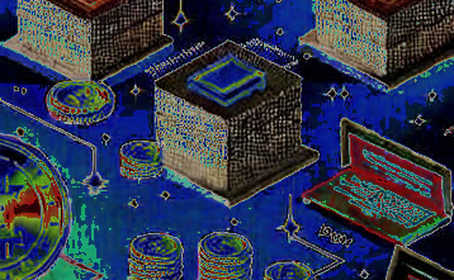
[Illustration: A futuristic customs inspection system with AI scanners and blockchain nodes, showing a contrast between opaque centralized AI and transparent distributed ledger.]